Safe and Compliant Use of Wheeled Loader MEWPs in Underground Mining
Safe and Compliant Use of Wheeled Loader MEWPs in Underground Mining
A new frontier for efficiency underground
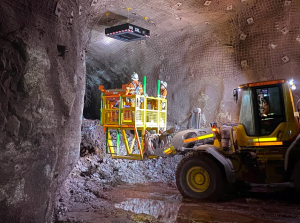
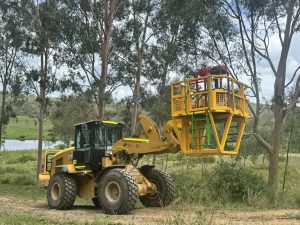
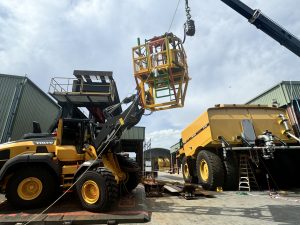
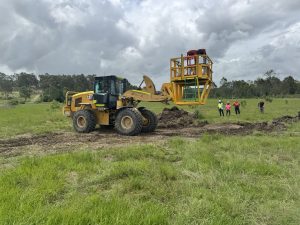
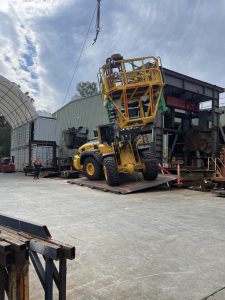
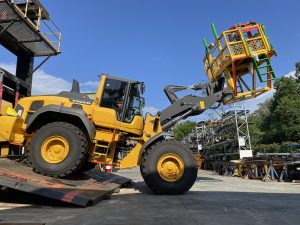
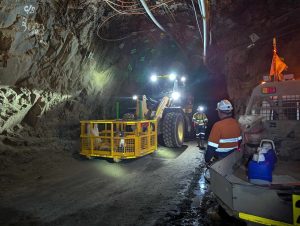
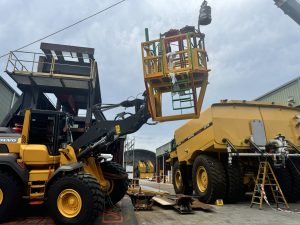
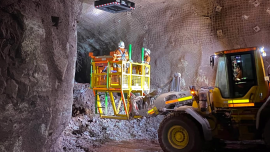
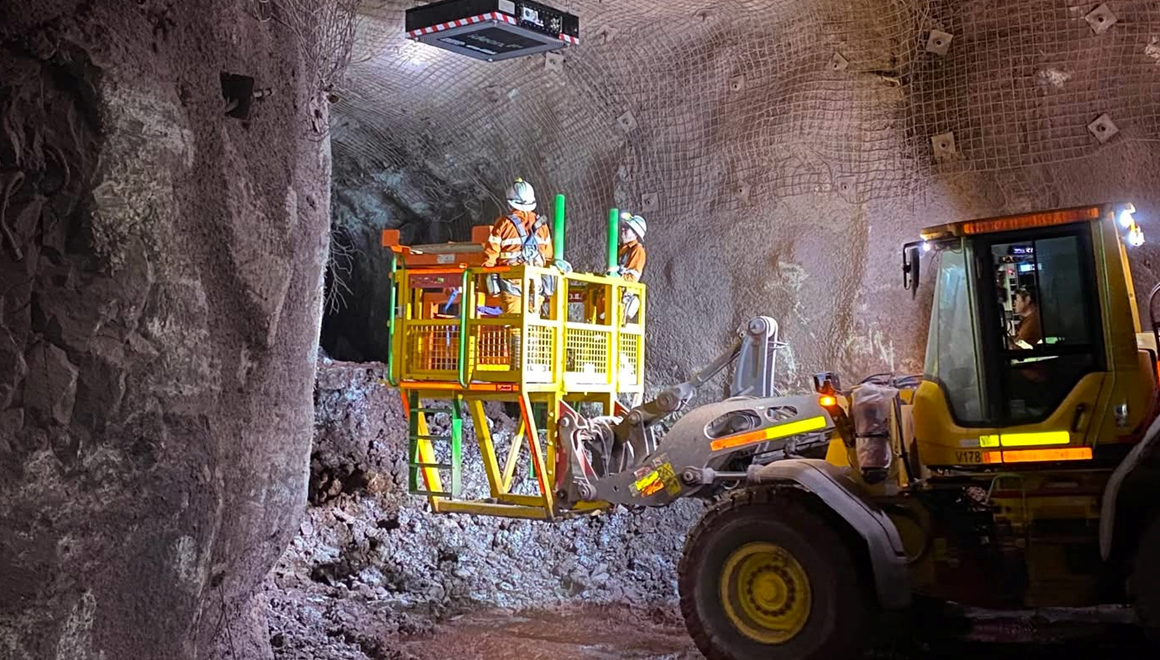
Across Australia’s underground hard-rock mines, the wheeled loader—or integrated tool carrier (ITC)—has evolved from a simple materials mover into a versatile, multi-function workhorse. When paired with a man-basket attachment, these machines can safely lift personnel to install services, charge blast holes, or perform scaling and ground-support work. For many operations, this flexibility has transformed productivity—allowing a single machine to haul, lift and elevate crews, eliminating the need for separate mobile elevating work platforms (MEWPs) or scaffolding.
However, with this versatility comes complexity. A loader was never designed as a personnel-lifting device. Once fitted with a work platform, it effectively becomes a MEWP—and must meet the same stringent safety, design and operational requirements that govern purpose-built boom or scissor lifts. This reclassification creates a grey area that many mines have historically managed through internal procedures rather than unified national standards. The result has been inconsistent practices and, in some cases, serious incidents.
Navigating Australia’s regulatory gap
Currently, no single Australian Standard directly governs the use of wheeled loaders as MEWPs. Instead, operators must navigate a patchwork of overlapping obligations—from general WHS legislation to standards for cranes and elevating work platforms. The lack of specific guidance has led to significant variation between sites: some prohibit all movement when people are elevated, others allow slow “tramming” under controlled conditions.
To bring clarity, industry bodies such as the Elevating Work Platform Association of Australia (EWPA) and the Telescopic Handler Association (TSHA) have issued information sheets recommending that all loader-mounted work platforms comply with AS/NZS 1418.10 (design and construction) and AS 2550.10 (safe use and maintenance). These standards, although originally written for purpose-built EWPs, now form the benchmark for compliance in this fast-evolving space.
Understanding the key standards
AS/NZS 1418.10 requires every MEWP to demonstrate robust engineering integrity: static and dynamic stability tests, overload protection, emergency descent systems, dual-circuit hydraulic load-holding valves, rated capacity limiters, and interlocked controls that prevent unsafe operation. For a loader MEWP, this means adding engineered systems to monitor stability, restrict speed and height, and enforce safety interlocks when a platform is attached.
AS 2550.10 complements the design standard with rules for operation and maintenance—daily pre-start checks, frequent inspections, six-monthly engineering reviews, and major ten-year rebuilds. It also specifies operator competence, inspection records and risk management. Mines that treat a loader MEWP merely as earthmoving plant risk missing these obligations, leaving critical safety systems untested and unverified.
In most jurisdictions, any boom-type platform exceeding 2.4 m in reach must be design-registered and subject to periodic verification, while units that lift above 11 m require operators to hold a High-Risk Work Licence (WP). These steps formalise safety assurance and ensure that personnel operating such machines are appropriately trained.
Managing stability and operational risk
When a loader carries an elevated basket, its centre of gravity rises dramatically. A small pothole or rock can shift that balance enough to cause a tip-over or violent “catapult” motion ejecting occupants from the platform. Incidents in Western Australia and New South Wales have shown that even minor shocks can throw workers from a basket if not properly restrained or if travel occurs on uneven ground.
The hazard is amplified underground, where tight clearances and low backs introduce crushing risks between the basket and the mine roof. A number of serious injuries have occurred when operators moved baskets too close to services or failed to use spotters.
To manage these hazards, mines must classify loader MEWPs as Group B, Type 2 platforms—machines where the platform extends beyond the chassis footprint and travel is controlled from the base. Type 2 systems require strict controls on movement with the platform raised. Limiting travel speed to under 2.5 km/h, restricting height, using continuous communication between operator and occupants, and selecting smooth travel paths are all essential. In many cases, adopting Type 1 operation—no movement while elevated—remains the safest option.
Engineering controls: the Q-PILOT advantage
Recognising the limitations of manual control, leading manufacturers such as QMW Industries have developed purpose-built electronic control systems that transform loaders into certified MEWPs. The Q-PILOT™ MEWP control system, developed in collaboration with Q-Systems, is an advanced electro-hydraulic platform that enforces compliance with AS 1418.10 and AS 2550.10.
Q-PILOT integrates dynamic stability monitoring, inclination sensors, load-sensing hydraulics, proportional movement controls, and automated interlocks. When a work platform is connected, the system automatically recognises the attachment, limits ground speed to a crawl, disables unsafe functions, and engages safety logic across both the loader and basket. Dual emergency-stop circuits and ground-level descent controls provide redundancy.
These intelligent safeguards allow mines to choose risk-based modes—Type 1 for static work or Type 2 for slow tramming on level ground—without relying solely on operator discretion. In doing so, Q-PILOT bridges the regulatory gap by embedding compliance into the machine itself, ensuring safe performance under all foreseeable conditions.
With more than 200 installations across Australia and abroad, Q-PILOT has become the de-facto benchmark for engineered control in integrated tool carriers, combining efficiency with unrivalled safety assurance.
Legal duties and mine-site responsibilities
Under the harmonised Work Health and Safety Acts, mine operators (as PCBUs) carry a non-delegable duty to provide safe plant and systems of work. When deploying loader-mounted work platforms, this duty translates to several key responsibilities:
- Engineering verification – ensure the loader-platform combination is certified by a competent engineer and meets AS 1418.10 design requirements.
- Comprehensive risk assessment – identify hazards such as falls, crush points and tipping; document control measures; and review regularly.
- Safe operating procedures – include mandatory pre-start checks, communication protocols, and explicit limits on travel while elevated.
- Competent training – ensure operators hold appropriate licences and platform users understand emergency descent and communication systems.
- Inspection and maintenance – adopt the AS 2550.10 inspection schedule, covering quick-hitch pins, welds, safety harness anchors and electronic safety devices.
- Continuous improvement – investigate all incidents or near misses and act on industry bulletins to update procedures.
By embedding these obligations into their Safety Management Systems, mines can demonstrate due diligence and significantly reduce the likelihood of catastrophic events.
Lessons from the field
Real-world incidents underline what’s at stake. Fatalities and serious injuries have resulted from basket detachment, hydraulic failures and inadvertent control activation. In several Western Australian cases, quick-hitch “dog-bone” connectors failed, causing platforms to fall; in others, operators were crushed against the roof or ejected after sudden jolts. Investigations consistently identified the same root causes: non-compliant equipment, inadequate inspections, and missing interlocks or procedural controls.
Each case reinforces the necessity of engineered safety systems like Q-PILOT, adherence to AS 1418.10/2550.10, and rigorous operator training. Where these were in place, mines have demonstrated excellent safety performance while retaining the operational advantages of loader-based platforms.
QMW’s commitment to safer, smarter mining
QMW Industries’ leadership in this field extends beyond technology. The company provides full engineering validation—static and dynamic stability testing, design registration, certification and operator documentation—ensuring every installation meets or exceeds statutory obligations. Its engineering and manufacturing teams conduct 200 % load-testing to confirm safety margins and integrate custom hydraulic and electrical systems that align perfectly with mine-site conditions.
By combining mechanical engineering excellence with electronic intelligence, QMW delivers a holistic approach: safer machines, compliant documentation, and sustained operational productivity. As underground mines push deeper and demand higher utilisation from equipment, Q-PILOT and its integrated control philosophy set the benchmark for compliant, efficient work-at-height solutions.
The path forward
The message from regulators and industry is clear: loaders used as work platforms must be treated—and engineered—as true MEWPs. Compliance is not optional; it is the foundation of safe productivity underground.
By adopting standards-based engineering, advanced control systems, and robust training, mining companies can harness the efficiency of loader MEWPs without compromising safety.
QMW Industries continues to champion this transformation—bridging the gap between innovation and compliance, and proving that with the right technology, working at height underground can be both safe and smart.